 ← Back to Blog
If you’ve ever had a giant competitor move into your market and immediately start throwing discounts around like confetti at a New Year’s Eve party, you know the feeling. Suddenly they’re everywhere. Their ads are everywhere. Their salespeople are everywhere. Their billboards are everywhere. It’s enough to make a small business owner start questioning every marketing decision they’ve made since approximately 2017.
That’s one reason I was excited to have Sandy Hendrick on my podcast, Underestimated: The Small Business Advantage. He’s the Marketing Manager for HTC, a local-market internet service provider in Conway, South Carolina, and they’re living through exactly this situation right now. They’re competing against companies with bigger budgets, bigger teams, and more resources. Like… seriously bigger.
The easy response would be to start slashing prices and trying to look more like the competition. Instead, they’re doing something much smarter. They’re doubling down on the one thing their competitors can’t easily copy: genuine community connection.
When Everyone Sounds the Same, Nobody Stands Out
One of the things Sandy said that immediately resonated with me was how difficult it can be to stand out when everybody in your industry sounds exactly the same. Think about it. How many websites have you visited recently that promised exceptional customer service, unmatched quality, innovative solutions, and a commitment to excellence?
(Warning… incoming Gen X pop culture reference.)
If you’re rolling your eyes right now, it’s because you’ve seen those phrases about seventeen thousand times. Every company claims they’re different while using the exact same language as everybody else. It’s the marketing equivalent of showing up to a costume party and discovering that everyone accidentally wore the same outfit. You remember that episode of Friends where everyone showed up as the same Halloween costume? Monica as a cat, Chandler in a bunny suit, and nobody winning? That’s your industry website right now.
Sandy reminded me of a role-play exercise I’ve led at conferences where we both crossed paths. I ask the audience to shop for a service in a random local market — visiting several provider websites, comparing what they find. Every single time, the results are the same. Every company is talking about speed, reliability, and customer service. Nothing stands out. Nothing feels different. So what do people do? They pick the cheapest one, because when there’s nothing else to differentiate, price is the only remaining decision-maker. That should make every business owner just a little uncomfortable, because customers can’t choose you for what makes you different if they can’t figure out what makes you different in the first place.
This is where a lot of businesses accidentally drift into commodity territory. It doesn’t happen because they’re bad at what they do. It happens because they become so focused on sounding professional that they sand off all the interesting parts. They stop sounding like themselves and start sounding like an industry brochure. Somewhere along the way, “professional” became confused with “forgettable,” and every single one of them blended into what I call The Blandscape.
The Customer Who Only Cares About Price Is the One You’ll Lose Again
What I appreciate about HTC is that they made a conscious decision not to compete on price. Not because they couldn’t offer promotions or run deals, but because they understand something most businesses learn the hard way: the customer who chooses you solely because you’re cheapest will leave you for the exact same reason the moment someone else undercuts you.
As Sandy put it, if somebody’s primary motivation is saving a few dollars a month, you’re signing up for an endless game of churn. You win them, you lose them, you replace them, repeat. That’s exhausting. And expensive.
Instead, HTC focuses on a bigger story. Their mission isn’t to be the lowest-priced provider in the market. It’s to enhance and enrich the lives of the people they serve and improve the communities around them. That’s not marketing copy hung on a wall in the break room. It’s a decision that affects how they actually show up every single day — the partnerships they create, the events they support, the conversations they have with customers. Most importantly, it gives people something to connect with beyond a monthly bill.
Dogs, Pizza, Santa, and the Best $200 Marketing Idea You’ll Hear This Year
One of my favorite examples from our conversation involved a pizza shop, dogs, Santa Claus, and a local animal charity. If someone had told me those four things would turn into a marketing lesson, I probably would have been skeptical. Then again, some of the best marketing lessons arrive wearing fur and begging for treats.
A local pizza shop announced a photos-with-Santa event for dogs. Sandy’s team saw an opportunity. They partnered with the pizza shop, made a donation to a local animal rescue, and offered a gift card giveaway. The whole thing came together quickly and cost very little. It wasn’t a massive event. Hundreds of people didn’t show up. There was no giant media buy attached to it.
What happened instead was much more valuable. The pizza shop promoted it. The rescue organization promoted it. Dog owners shared their photos. Community relationships got stronger. Everybody involved benefited. That kind of goodwill doesn’t show up in a cost-per-click report, but it builds something that paid advertising rarely does: genuine trust.
Small Events, Big Results
This is the part I think small business owners miss most when they’re comparing themselves to larger competitors. We tend to assume bigger is always better. Bigger event. Bigger audience. Bigger budget. Bigger reach. Meanwhile, some of the most effective marketing you’ll ever do happens in surprisingly small moments.
Sandy talked about events where maybe twenty-five people showed up. Twenty-five doesn’t sound impressive on paper. It sounds like the number of people who accidentally wandered into the wrong conference room. But if those twenty-five people have meaningful conversations, leave with a positive memory of your brand, and tell other people about you, the impact can far exceed a giant event where you’re competing with dozens of other vendors for two seconds of attention.
Community trust is less glamorous than a big media buy, but it compounds. Every relationship built, every event attended, every organization supported adds a layer to something your competitors genuinely cannot replicate — especially the big ones, who are too busy being “professional” to show up at a dog photo event with Santa.
Loyalty Isn’t Built Through a Single Campaign
What HTC understands — and what most growing businesses eventually learn — is that loyalty isn’t built through a single campaign, a single sponsorship, or a single event. It’s built through repetition. It’s built through showing up over and over again. It’s built through supporting businesses, organizations, schools, and causes because they matter to the community, not because you’re trying to squeeze an immediate ROI out of every interaction. That’s a longer path. It’s also a much stronger one.
Sandy’s advice for businesses that tend to overthink this stuff: don’t. If you hear about a community opportunity that fits your brand, act on it. Over-planning is where good ideas go to die. The best community marketing tends to be opportunistic and genuine, not strategically engineered to within an inch of its life.
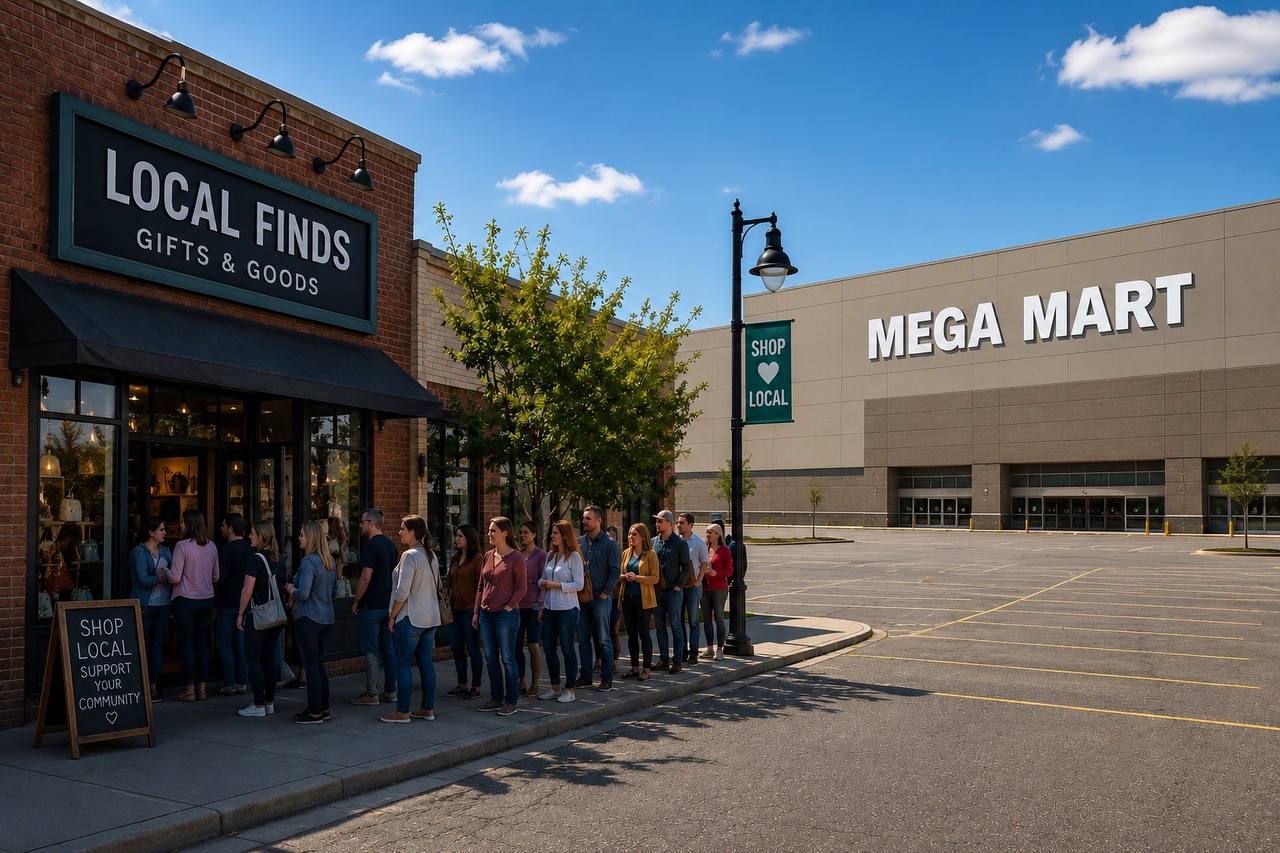
If you’re facing bigger competitors in your market, the answer isn’t to try to look more like them. Your customers already have access to companies that are bigger, flashier, and better funded. What they can’t get from those companies is you — your story, your relationships, your local knowledge, your presence in the community. Those things are your advantage.
The sooner you start treating them that way, the harder you become to replace.
(And the sooner Sandy becomes the unofficial mascot of every dog-friendly pizza partnership in South Carolina.)
Listen to the full conversation with Sandy Hendrick on Episode 20 of Underestimated: The Small Business Advantage Podcast.