 ← Back to Blog
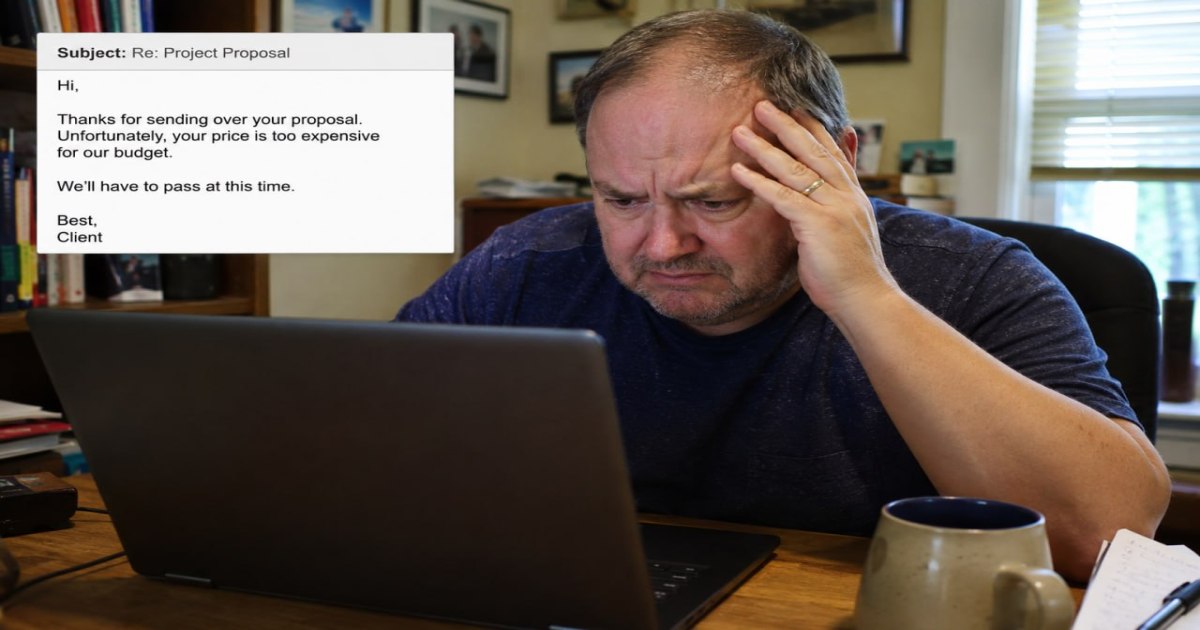
Nobody likes hearing those words. You’re sitting there thinking the conversation went well. You answered every question, you explained what makes your business different, and maybe they even told you how much they liked you. Then the email shows up.
“We’ve decided to go with someone less expensive.”
It’s enough to make you stare at your pricing sheet and wonder if you should start chopping numbers. Sometimes that’s exactly what business owners do. They shave a little off the price, throw in an extra service, or create a “limited-time discount” they secretly hope nobody actually uses.
Thanks, but I’d rather sit in a middle seat on a five-hour flight than race to the bottom on price.
Now, to be fair, your pricing really could be the issue. Markets change. Competitors change. If you haven’t looked at your pricing in a while, spend an afternoon doing a little homework. Secret shop a handful of competitors that are actually comparable to you. If you’re a premium brand, compare yourself to other premium brands. If you’re a value brand, stay in that lane. Otherwise, you’re comparing apples to waffle irons.
But here’s what I’ve found after years of working with small businesses. Most of the time, the price isn’t the real problem. Customers simply don’t understand why you’re worth what you’re charging.
Those are two completely different things.
Think about the last time you needed a service you didn’t know much about. Maybe it was a roofer, a landscaper, or someone to remodel your kitchen. You pull up a few websites and before long they all start sounding suspiciously alike. Great service. Family owned. Experienced team. Quality workmanship.
After the fourth website, they all blur together.
So what do you compare?
Price.
Honestly, I don’t blame people for doing that. I’ve done the exact same thing. If every business looks the same, the only thing left to compare is the number at the bottom of the quote.
That’s why I always tell business owners to look beyond pricing before they start giving away profit.
Take a hard look at your branding. Not just your logo, but the overall impression your business gives people. Maybe your business has grown over the years but your website still looks like the company you were five years ago. Maybe your photos are all stock images. Maybe your marketing feels a little…generic. Customers notice those things, even if they can’t explain why.
Then there’s your messaging. This is one of those areas where we’re often too close to see the problem ourselves. We know exactly what makes us different, so we assume everyone else sees it too. They don’t.
If your website says the same things every competitor’s website says, customers have no reason to believe your business deserves a higher price. They aren’t rejecting your value. They just haven’t seen it yet.
Value is another funny thing. We all think we’re delivering plenty of it because we’re the ones doing the work. But customers decide value based on what they understand before they buy, not after. If they can’t clearly see why your business is different, they’re naturally going to compare you with someone charging less.
Then we get to the biggest one of all: trust.
Trust has changed dramatically over the last few years. People are more skeptical than they’ve ever been, especially of businesses that look a little too polished. A perfect website, perfect photos, perfectly crafted marketing…it can start to feel a little manufactured.
I’d rather see a slightly crooked picture of your team laughing than another stock photo of people in suits pointing at a laptop. I’d rather hear a customer tell me why they love working with you in a video they recorded on their phone than read another anonymous testimonial that says, “Great service!”
Real beats perfect.
That’s one of the biggest advantages small businesses have right now. We don’t have to pretend to be corporations. We don’t have to sand off all our personality. We get to be approachable. We get to be honest when something goes wrong. We get to introduce customers to the people behind the business instead of hiding behind polished marketing.
When customers trust you, your price makes a lot more sense.
So the next time someone tells you you’re too expensive, don’t immediately reach for the discount button. Instead, ask yourself why your price felt expensive to them in the first place.
You may discover you don’t have a pricing problem at all.
You have a trust problem, a branding problem, or a messaging problem.
The good news? Those are all fixable.
And unlike lowering your prices, fixing those things keeps paying you back long after the discount would have been forgotten.