
How Can Small Businesses Attract More Gen Z Customers?
with Shawna Suckow
Listen Now
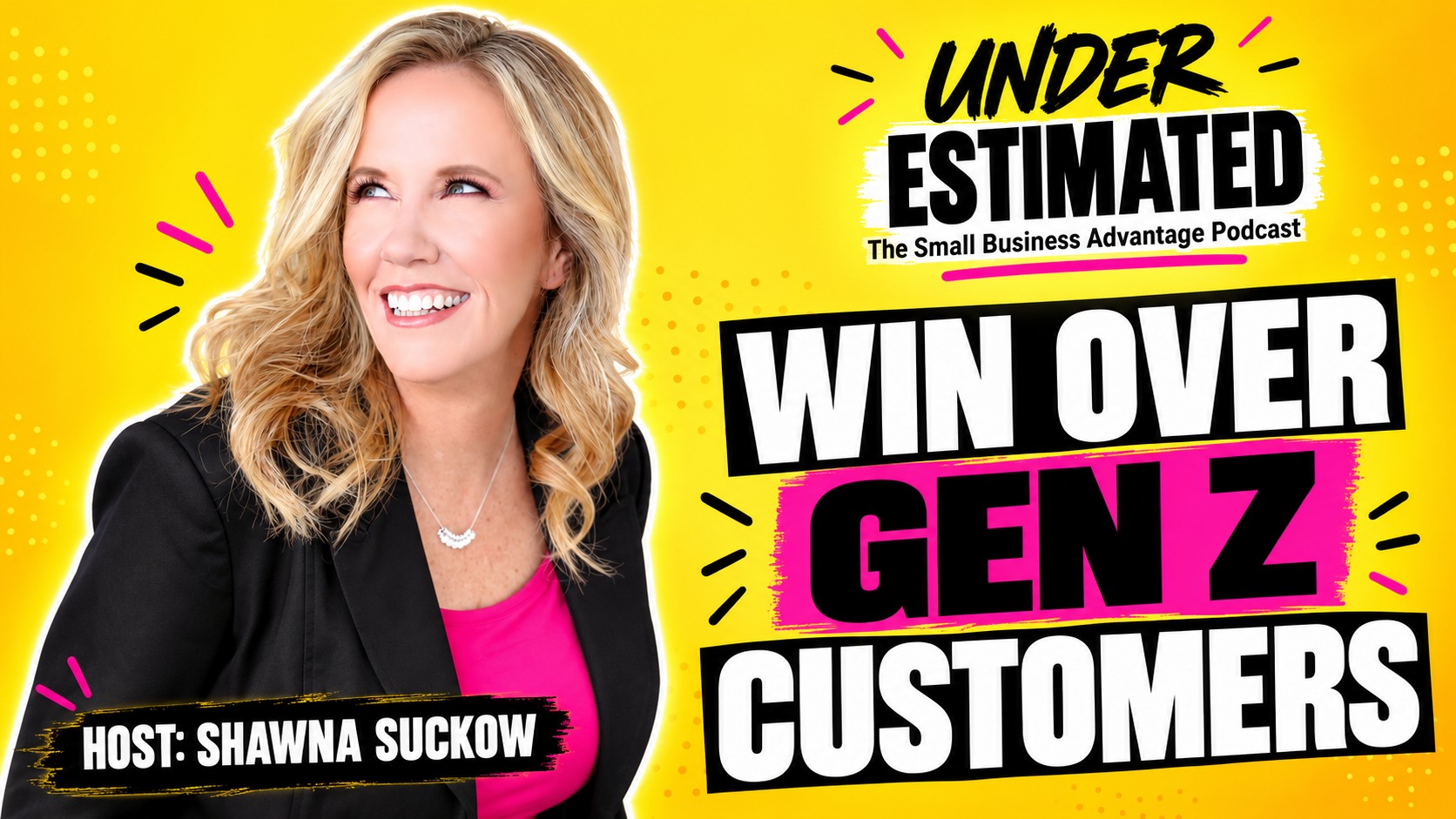
Win Over Gen Z Customers
Watch the Episode
Watch on YouTube
If you want more Gen Z customers, complaining about Gen Z probably isn't your strongest marketing strategy. I was recently on a podcast where the conversation turned into bashing this generation, and it got me thinking about how much business we can miss when we confuse unfamiliar behavior with a character flaw.
In this solo episode of Underestimated, I talk about how small businesses can attract Gen Z customers and build relationships that bring them back. We get into showing the real people behind your business, asking younger customers for input, letting happy customers tell your story, and making social media feel less like an endless sales pitch. You don't need to become a different person or chase every trend. You do need to give people a reason to pay attention and trust you.
I'm Gen X, I have two Gen Z kids, and I still learn plenty by listening instead of assuming I already know what younger customers want. A college reunion and a conversation with current students brought that home again. There's a lot we can learn from the people we're hoping will buy from us, if we actually invite them into the conversation.
I share practical ways to do that, including customer testimonials, behind-the-scenes videos, employee spotlights, and a customer advisory group that includes the people you want to reach. We also talk about giving a Gen Z employee or intern room to contribute ideas, while keeping clear expectations and approval of what represents your business.
What You Will Learn
- How to make younger customers feel represented in your marketing.
- How to ask for useful input from Gen Z customers and employees.
- What to show in behind-the-scenes videos without a production budget.
- How customer stories can help people picture doing business with you.
- Why your platform choices should follow your customers rather than your own habits.
Episode Chapters
Frequently Asked Questions
How can a small business attract Gen Z customers on a limited budget?
Start with customer conversations, phone videos of everyday work, and answers to common buying questions. Invite younger customers to offer input and share their experiences if they're comfortable doing so. Choose one or two platforms based on your audience and track whether the activity produces useful conversations or inquiries.
What should a small business post to build trust with Gen Z customers?
Show the people doing the work, explain how a product or service works, and answer questions clearly. Customer stories and demonstrations can give buyers specific information to evaluate. Support claims about your values or practices with examples people can understand.
Does attracting Gen Z mean posting on every social platform?
No. Focus on places your intended customers use and where you can participate consistently. Check your own customer feedback and results before adding another platform, rather than creating accounts you won't have time to maintain.
How can I ask a customer for a video testimonial?
Ask at a moment when they're already sharing positive feedback, explain where you'd like to use the recording, and get permission before sharing it. Keep the request easy to decline and let them use their own words. A clear, specific account of their experience is more useful than a sales script.
Full Transcript
Read the Episode 36 transcript
0:18 - 1:12
We're talking about Gen Z today, and if you want more of them as customers, then this is a great episode for you to listen to. So I went to a very small college of 1100 students, and it's so small that we go back for homecoming at appropriate intervals. So I was back for one of my sort of important years of a reunion.
It wasn't 10 years and it wasn't 50 years. Let's just say it was somewhere in between. And my sorority, the current members, the current students, post a gathering for any returning alums, and it got me thinking about Gen Z. And I also have to say I have two kids that are both Gen Zs, and so Gen Z is second nature to me, I guess.
1:13 - 2:14
But what really prompted this episode was I was a guest recently on somebody else's podcast, and it got to the point where they were bashing Gen Z. And I think a lot of that is just misunderstanding them. And so if you are not Gen Z, and you want more of them as your customer, then give this a listen. Some people say that Gen Z was born as early as 1997.
I don't believe that. I believe that they were born around the turn of the millennium, because I have nieces and nephews that were born in 1997, and they are so different from my daughter who was born in 2000. So let's talk about Gen Z as if they are 26, 27 at the oldest, and as the youngest, they can be as young as 13.
2:14 - 2:43
But again, I've got a bonus kid who's just turned 13, and he seems fairly different. Time will tell, but he seems fairly different from my kids who are both Gen Z. So a couple things to note about Gen Z, I found some statistics. 45% say they spend more in stores versus 37% who say they spend more online, and in between are the Gen Z who do both pretty equally.
2:44 - 3:25
73% of them said they shop in person, in store, once a week. So if you own brick and mortar, these are important customers, and they're approaching their late 20s, meaning they have careers and they have money to spend, not my kids yet, but some kids. So we need to really understand who this generation is, and I hate generalizations, but I'm going to give you some of the features, their priorities, if you will, that I kind of agree with in aggregate.
3:25 - 3:41
So they are, I think, the generation that demands the most authenticity to date. They have a BS meter that tracks BS from miles away and they hate it. They want what's real.
3:43 - 4:36
They want to be included. This is kind of along the lines of millennials. They want to be included.
They want to be a partner in shaping things, especially if they're your employees. That's another episode that I will be doing. But as your customer, they love to be asked for their input.
I would ask them for suggestions, testimonials. I would ask them for help shaping products or offerings. I would have them, if you have a customer board of advisors, which I recommend you do, I would absolutely have Gen Z represented on that, because I believe that the way that they move and behave on social media is something we, I'm a Gen X myself, that we as certainly Gen X and boomers, but also to some degree, millennials can really learn from.
4:38 - 4:43
They want value for their money. Of course they do. I think that's a generalization.
4:43 - 5:42
We all have, but because they're at the beginning of their career and the housing market is the worst it's ever been and the hiring market is not great. They are probably among the lowest income of the generations that are still full time in the workforce. And what they need from us is we need to earn their attention and their trust.
I think more than most, they are the hardest generation to earn their attention because they live online. They were born online. Of course they are going to live their lives online.
And so they are so skeptical of noise, and they tune it out so well, more than the rest of us do. And because they want authenticity, and they have a BS meter that's on high alert, it's harder to earn their trust. So we have to do a couple different things.
5:43 - 6:18
So let's talk about how we can win Gen Z as customers and keep the ones that we have. If they were maybe they were price shopping and found us, or maybe they have bought from us once but not a second time. So how do we deepen the relationships with the Gen Z customers we already have and how do we attract new ones? First and foremost, I believe that this is the toughest generation to stand out to on social media and the toughest generation to build trust with.
6:19 - 6:36
As far as standing out goes, they were born on social media. A lot of millennials were too, but not as much. There weren't as many platforms available to them, to millennials, when they were in their teens.
6:37 - 7:10
This generation, Gen Z, they have had social media at their disposal their whole lives and it's been up to their parents when they get access to that. But I would say tweens, those about to become teenagers, were on social media platforms that were available to them and have been on ever since. So they are so used to tuning out noise, like the rest of us are, but they're better at it, because they've been bombarded since they were young.
7:10 - 7:33
And we learn our formative habits the most, the younger we are, especially in our tween and teen years. So they're super good at ignoring us. And because they demand what's real more than other generations because of what they have lived through, it's harder than ever to build trust with them.
7:33 - 8:12
So we have a bit of a challenge on our hands. If we are not Gen Z, there are so many Gen Z's that have started side hustles and started full blown businesses, because they are so prone to saying, Yeah, the job market is just not for me, I'm not having success. I'm going to start my own or I don't want to work for the man.
That's such a Gen X and Boomer phrase to use that a lot of them are small businesses. So if you are a Gen Z, you don't need to listen to this episode. I am preaching to the choir and you are fantastic at attracting more Gen Z's like yourself.
8:13 - 10:49
Where you might struggle is attracting older generations. And I will do an episode on that now that I've thought of that to help you and younger millennials to do that. So let's unpack.
How do we stand out with them? Well, as a Gen X, what I believe the best thing you can do to stand out to other Gen Z's is to hire a Gen Z to help you with your social media, certainly to post occasionally as the face of your business, you should have multiple faces of your business. It shouldn't always be you. Even if you're a solopreneur, it should not always be you.
Most of the time if you're a solopreneur, it's going to be you because there aren't other people, but I would enlist interns who are Gen Z's. I would enlist customers to tell your story through our Gen Z's and other generations as well from time to time because like attracts like. And we are prone to trust those who are most like us.
That's part of our lizard brain. So having another Gen Z post a video of themselves talking to your audience is not going to push away older generations at all. They are just going to scroll right on by if it's not enticing to them.
They're going to tune it out like we all tune things out that don't appear immediately relevant. But man, it's going to land with other Gen Z's. So the first and foremost to stand out, use them.
Tell stories about them if it's you. Tell stories about Gen Z's that you've worked with. Tell stories about customers of yours who are Gen Z. And that same thing, all those same things I just talked about, build trust.
They build trust because you are talking to them, whether it's you or you're talking about Gen Z and it's going to stand out to them. Certainly, we need to talk about their priorities if they are true for our business. Gen Z is the strongest proponent of the environment.
Now, these are all generalizations, but we have not had a generation so active in the environment and protecting it as this generation. There are actually statistics on that. So not every Gen Z, but by and large, they do care more about the environment in numbers of them than other generations.
10:50 - 11:24
And so if you are environmentally conscious or you carry products that are or you do services that are related, it's really important to talk about that. Some generations may not care about the environment as much or some people may not. It's okay again.
They're going to tune out to those videos and posts. If your business is all about the environment, then most of your social posts, most of your website is going to be talking about that anyway. So not a big deal for you to spend most of your time talking about it, if that's what you do.
11:24 - 12:04
But certainly, if it's only a part of what you do or a part of your offerings or just certain products that you have, spotlight those from time to time. It's going to resonate with Gen Z more than other generations. And fairness.
If you talk or post about fairness for your employees, fairness in the economy, fairness in politics, fairness, fairness, fairness. And this is not to say everybody gets a trophy. That's a common conception or misconception of millennials.
12:06 - 14:32
Hey, it's Shawna interrupting myself here to say if you or your brother or your neighbor or your cousin, anybody you know works for or belongs to an association or a chamber anyplace small businesses gather. And if they have conferences or webinars or anything where they bring in professional speakers, I would love to be introduced or just to be able to drop your name for a little extra oomph in the conversation that I would have with them. So please connect with me on social or drop me a line through my website text or email me.
I'm at the buyer insider.com. Thanks. If you think about when generations are most formed in their beliefs, it's based on, as I said, their tween and teen years and what was going on in their lives at that time. And so what this generation has experienced is COVID isolation.
They've experienced government mishandling a lot of things regardless of which party you're with government mishandling. They've experienced widespread fraud that they hear about on social media, whether it's where whether it's perpetrated by government or other businesses, especially big business. And so they are more like me for the underdogs and getting a fair shake because they have not gotten one in the job market.
They have not gotten one in housing if they're living on their own. Costs have skyrocketed for them during their formative years. They've seen their parents struggle.
So there's a there's just been a lot of change and upheaval. And so fairness and talking about change and upheaval and talking about what's real and being vulnerable, how it's impacting you and what your business is doing to help your customers deal with all of that. Those are going to be important.
And all of those build trust in this not skeptical, more like jaded because of their life experiences, but even that's kind of a strong word. They are actually overwhelmingly optimistic about their future. It's not the future of the United States or, you know, whatever.
14:32 - 15:39
But they are optimistic about their future. So couch that in hope, but absolutely be vulnerable and be honest. And as I've said about every small business owner, you have to share your personality.
You have to share behind the scenes. They want to know what goes into the making or the doing of the thing that you're selling. If you are retail, show behind the scenes.
Show your loading docks. Show what your back of house looks like and how you prep things and how you display things or hang things. It's a curiosity factor that a lot of us have.
And so showing, especially though, the people that do the thing and perform the service and whatever in your business, showing the people. And not just the people that are on the front line, all the people. You have probably, if you follow me on socials, you've seen examples of me sharing tiny mic videos.
15:39 - 15:59
I love the tiny mic videos where somebody goes around and asks employees behind the scenes with a little tiny microphone. That's why it's called a tiny mic video. And you can Google tiny mic video or search those on YouTube and lets the employees behind the scenes either talk about work or talk about themselves in a fun way.
16:00 - 16:50
AARP, sorry, younger generations, but AARP does a fantastic job of this on TikTok, where they do name the song and different generations struggle with it and so forth. But they're not talking about AARP all the time. They're humanizing their workers and that is hard to do for a huge organization.
So kudos to them. And also because I'm approaching membership age. This generation, because their BS meter is on high alert, they don't want to always be pitched.
And as I say in general, do not pitch. Every post on your social media should not be a pitch. In fact, the minority of your posting on social media should be a pitch where you're trying to sell something or promote a sale.
16:51 - 18:43
We want to spend, if you post, let's say you post every weekday, one of those posts should be a pitch or a promotion or less because you're going to turn off not just Gen Z, but especially Gen Z. And so what you're trying to do is create community and create conversation and humanize your business, humanize your customers. Talk about them. Talk about what's going on in your community.
Talk about the idea that you thought of over coffee this morning or spotlight an employee talking about their favorite part of your business. See, that's a promotion without being a promotion. They're promoting the business without saying, hey, buy our widgets.
So that definitely. And I touched on briefly letting Gen Z be part of shaping your messaging. And on both sides, whether they're your employees or whether they're your customers, help your employees tell your story by giving them the camera every now and then.
And also, it's always fantastic to let your customers tell your story. And so if you have a Gen Z that's in your physical building or has hired you to come to their house or work on their car or whatnot, and they are raving about any part of your going, thank you so much. That is the time when I say, would you mind repeating what you just said into my phone? And Gen Z is more likely than other generations to say, of course, you can use this on social media because they understand how social media works.
18:43 - 19:04
And they're used to, they live on social media more than the rest of us, and they're used to being on it. So ask them, ask any happy customer. This isn't just Gen Z, but like attracts like, and so do this for any generation or customer base that you want more of.
19:04 - 20:16
If you want more women customers than target women, if you want more of a certain age or a certain financial status or whatever, but we're talking about Gen Z here, so let them shape your messaging. And then this one's important. I harp on how especially the smaller the business that you are, don't try to be on every platform.
I know you feel compelled to because you want to expand your reach as much as much as possible. But as I say, it's better to be consistent on one or two platforms than it is to be, you know, throwing spaghetti at a wall every now and then on all the different platforms. So how that relates to Gen Z is you will not find Gen Z on Facebook.
So if you're doing most of your promotions on Facebook because you are on Facebook, then you are doing yourself a disservice. If you're advertising on Facebook and you put the age as under 30 for those targeted ads, you're wasting your time. If you even include, I want to reach 25 to 60 year olds, forget it.
20:17 - 20:43
I would say 35, really. They aren't much on Facebook except for maybe once or twice a year on their birthday, maybe to see which of their relatives wish them a happy birthday. But be on the social media channels that Gen Z is on.
And Gen Z is largely on Instagram and TikTok. They're on Snapchat, but meh. And I think they're also on Reddit.
20:44 - 21:17
So be where they're at if you want a lot more Gen Zs at the expense of not spending as much time on other platforms because you don't have an infinite amount of time as a small business. So again, this is a great job for an intern. If you hire an intern who is a Gen Z, put them on those platforms under your logo talking about your business, being the face of your business on those if you are not already on those doing your own thing.
21:17 - 22:27
And turn them loose. Of course, you want to, you know, occasionally check in, especially beginning with approval of what they're posting and so forth, but turn them loose as far as their ideas, because they know what's going to resonate. But be on the socials that they're on.
For any demographic that you are trying to reach, if you overwhelmingly want to reach Boomers, Facebook. If you overwhelmingly want to reach Gen X, we are Facebook, Insta. I'm a huge TikTok fan.
I think a lot of my generation is, but by and large, if you're only going to be on one or two, those are the ones. And actually I have a whole other video on social media and different platforms and why you should focus on just one or two. And if your business is B2B, you have to be on LinkedIn.
And a lot of Gen Zs are not on LinkedIn yet. They hate it. Talking to the sorority women who were hosting our get together at my college reunion.
22:30 - 22:58
I was telling them, you all have to be on LinkedIn and LinkedIn with all of us as alums, because we want to help you. But if we can't find you, how can we help you? So be on LinkedIn if you're B2B, and otherwise focus on where your demographic is. If you want more Gen Z, but not entirely Gen Z, you don't need to waste your time on the platforms that they're exclusively spending time on.
22:59 - 23:31
As always, if you want to find this episode's show notes or its transcription or the related resources, the free resources that I have added to the episode page, just go to my website, thebuyerinsider.com. And under Resources, you'll see Podcast. Click there and choose any number of episodes that you want. They each have a dedicated page full of resources, full of Q&A, and full of all the things that you might want to do with that episode.
23:32 - 23:43
And again, if I can be helpful, schedule a 15-minute Ask Me Anything. You can do that through my website as well. Thank you for listening.
This has been another episode of Underestimated, and we'll see you next time.
Ask one younger customer what they wish businesses like yours understood. Then show one real person or process behind your business this week. Start with curiosity and something useful to share, and give people a reason to respond.