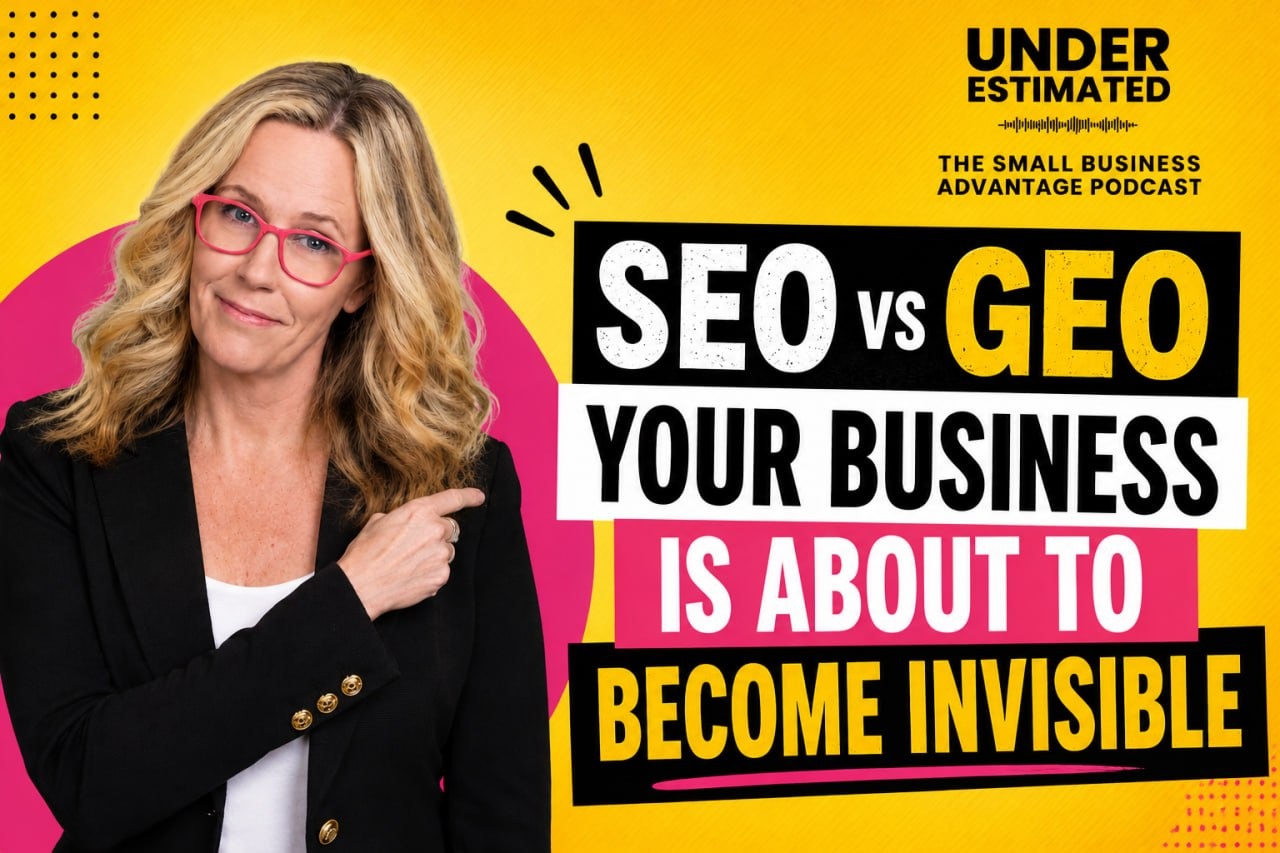
SEO vs GEO: Your Business Is About to Become Invisible
with Shawna Suckow — Consumer Behavior Expert & Small Business Marketing Strategist
Released Sunday, May 17, 2026
Search is changing faster than most small businesses realize, and the shift from SEO to GEO is not subtle. It is a complete rewrite of how customers find you. In this episode, Shawna Suckow breaks down why traditional search engine optimization is losing ground and how generative engine optimization is already deciding which businesses get recommended and which ones disappear. You will learn how AI tools like ChatGPT and Google’s Gemini are changing customer behavior, what signals actually matter now, and how to restructure your website and visibility so your business is trusted, surfaced, and chosen.
Watch It
Watch on YouTube
 ▶
▶ Watch on YouTube — opens in new tab
▶ WATCH ON YOUTUBE
▶
▶ Watch on YouTube — opens in new tab
▶ WATCH ON YOUTUBE
In This Episode
Key Topics Discussed
Why SEO Is Losing Ground
- AI tools now filter results before users see them
- Ranking on Google is becoming less relevant
- Customers are getting answers, not lists
- The old playbook is losing effectiveness
What GEO Actually Is
- Generative Engine Optimization explained
- How AI decides which businesses to recommend
- Why signals matter more than keywords
- Trust and authority over ranking
How Customer Search Has Changed
- Customers ask questions, not keywords
- AI interprets intent before showing results
- Behavior shift from browsing to asking
- What this means for your content
Why Small Businesses Are at Risk
- Generic content gets skipped by AI
- Lack of context = invisibility
- Larger competitors have more indexed content
- What you must fix now
The Small Business Advantage
- Specificity beats volume
- You can be more human and helpful
- Niche authority is a GEO superpower
- Authenticity signals trust to AI
What to Do Next
- Restructure content around questions
- Build pillar pages
- Use testimonials strategically
- Two platforms is enough — pick them and own them
Key Takeaways
The Bottom Line
- Ranking is no longer the goal — being recommended is. SEO gets you on a list. GEO gets you selected as the answer. If your content isn’t built for AI to trust and recommend, you’re not just harder to find — you’re invisible.
- Customers have stopped browsing and started asking. AI tools answer questions before users ever see a search result. If your content doesn’t answer real customer questions clearly and specifically, AI skips you.
- Small businesses have a real advantage here. You can be more specific, more human, and more contextually relevant than large competitors. Generic content loses. Deep, helpful, specific content wins.
- Pillar pages and testimonials are your two biggest GEO levers. Structured content that covers a topic thoroughly signals authority to AI. Real customer words in testimonials signal trust.
- You don’t need to be everywhere — you need to own two platforms. Pick the two platforms where your customers actually are and create consistent, helpful content there. Scattered presence dilutes your authority signal.
Read It
[Intro]
Have you ever struggled with how to get on the first page of Google? Well, you’re not alone. It’s a question and a challenge that every small business owner faces. And we’re going to tackle today how all of that is changing — and becoming more and more irrelevant. There’s a whole new thing to learn out there, and it is called GEO, not SEO. So we’re going to figure out what’s the difference, and how you need to change your website and visibility so that you can actually be found.
[Why Ranking on Google Is Becoming Irrelevant]
For years, the goal was simple: get to the first page of Google. You’d stuff keywords into your content, build backlinks, update your meta descriptions, and hope the algorithm noticed. And it worked. But something fundamental has changed. AI tools like ChatGPT, Google’s Gemini, and Perplexity are now sitting between your customer and the search results. When someone types a question, they’re no longer getting a list of ten blue links. They’re getting an answer. And that answer comes from somewhere. The question is whether it comes from you.
[What GEO (Generative Engine Optimization) Really Is]
GEO stands for Generative Engine Optimization. It sounds complicated, but the idea is simple: instead of optimizing for a search algorithm, you’re optimizing for AI. You’re making sure that when an AI tool is asked a question your customers are asking, your business shows up as part of the answer. The signals that matter now aren’t just keywords. They’re authority, trust, specificity, and context. AI doesn’t just index words. It evaluates whether your content demonstrates expertise, answers real questions, and can be trusted as a source.
[How AI Is Replacing Traditional Search Results]
When your customer types “what’s the best way to market a small business locally” into ChatGPT or Gemini, the AI doesn’t show them a list of websites. It synthesizes an answer from everything it has learned, and it recommends businesses, strategies, and resources that match its understanding of what’s trustworthy and relevant. If your business isn’t part of that knowledge base — if you haven’t been mentioned, cited, linked to, or written about in ways the AI can parse — you don’t exist in that answer. You don’t get a second-page result. You get nothing.
[Why Small Businesses Risk Becoming Invisible]
Large competitors have years of content, press coverage, backlinks, and brand mentions that AI has already absorbed. They’re already part of the answer. Small businesses that haven’t built a visible, specific, contextually rich digital presence are starting from scratch in a game that’s already underway. And if you’ve been relying on local SEO, basic blog posts, or social media posts without depth or strategy, AI has very little to work with when it evaluates whether to recommend you.
[How Customer Search Behavior Has Changed]
Think about how you personally search for things now. Are you typing in three keywords and hoping? Or are you asking a question in natural language and expecting a real answer? Most people are doing the latter. Your customers are asking AI assistants things like “who is the best flooring contractor near me who works with older homes” or “what marketing strategy actually works for a small retail store.” These are not keyword searches. They are conversational questions with specific intent. If your content doesn’t answer those specific questions in plain language, AI has nothing to pull from when building its response.
[Why Keywords Matter Less Than Questions]
SEO rewarded keyword density. GEO rewards question depth. Instead of asking “what keywords do I need to rank for,” you need to ask “what questions are my customers actually asking, and have I answered them clearly and completely on my website?” The businesses that win in a GEO world are the ones that have organized their content around the questions their customers ask at every stage of the buying process — from first awareness all the way to making a purchase decision.
[Where AI Pulls Information From]
AI tools learn from what’s publicly available and what’s been widely referenced. That means your website content, blog posts, customer reviews, local listings, social profiles, press mentions, and podcast transcripts all contribute to your authority signal. The more places your business is mentioned — and the more specific and helpful that content is — the more likely AI is to see you as a credible source. This is why reviews matter more now than ever. Not just for social proof with humans, but because AI reads reviews as signals of what your business actually does and who it serves.
[Why Small Businesses Have the Advantage]
Small businesses have a significant advantage in GEO. You can be more specific than a large competitor. You can speak directly to a narrowly defined customer. You can answer questions in a human voice instead of a corporate one. AI is very good at detecting authenticity, specificity, and relevance. A large national chain writing generic content about “marketing tips for businesses” is competing against thousands of similar pieces. A small business owner writing about “how to attract first-time home buyers to a small real estate office in a rural market” is almost certainly the only one. Specificity wins.
[How to Find the Right Customer Questions]
Start by listening. What do your customers ask you when they call? What do they say in reviews? What problems do they describe before they hire you? Those are your questions. You can also use free tools like Google’s People Also Ask section, Reddit threads in your niche, and even just typing a question into ChatGPT and seeing what it asks back. The goal is to build a library of real questions — the exact language your customers use — and then answer each one clearly and completely.
[Why Traditional Marketing Language Fails]
Here’s a trap a lot of small businesses fall into. They write their website content in marketing language. “We provide innovative solutions for all your business needs.” That sentence means nothing to a human, and it means even less to an AI. AI is looking for specificity, evidence, and clarity. It wants to know who you serve, what problem you solve, how you solve it, and what results your customers get. If your website talks about your business instead of your customer’s problem, it’s not giving AI what it needs to recommend you.
[Building Content for Context (Not Keywords)]
The practical shift here is from writing for keywords to writing for context. Instead of a blog post titled “Marketing Tips,” write one titled “How to attract customers to a small yoga studio when you’re competing with a big gym three blocks away.” That is a specific question with a specific audience, and AI knows exactly who to show it to. Every piece of content you create should answer a real question, address a real audience, and provide a clear, useful answer. That is what GEO rewards.
[The Pillar Page Strategy Explained]
A pillar page is a comprehensive, long-form piece of content that covers one topic in depth — not just a surface overview, but a real resource. If you’re a plumber, you might have a pillar page called “Everything You Need to Know About Water Heater Repair and Replacement.” It covers cost, lifespan, warning signs, DIY vs. professional, brands, and FAQs. AI can pull from a resource like that to answer almost any water heater question a customer asks. And if your pillar page is the best, most complete answer available, AI starts recommending it.
[How to Use Testimonials for GEO]
Testimonials are underused as a GEO asset. Most businesses collect them and display them on a page. But for GEO, you want to make sure your testimonials use the same language your customers use when they search. If a customer says “I was terrified of the renovation process and the team made it completely stress-free” — that’s a GEO asset. It tells AI that your business serves people who are anxious about renovation, and that you solve the stress problem. Get more testimonials, display them prominently, and make sure they’re in text form — not just images — so AI can read them.
[Why You Only Need 2 Platforms]
One of the biggest mistakes small businesses make is trying to be everywhere. They post on five platforms, create content for three different formats, and end up doing all of it badly. For GEO, what matters is depth and consistency, not breadth. Pick two platforms where your customers actually spend time. Own those completely. Post consistently, answer comments, and create real content — not repurposed fluff. Two platforms done well signals authority. Five platforms done poorly signals noise.
[Real Example: Updating a Website for GEO]
Before: “Welcome to Smith Landscaping. We offer residential and commercial services.” After: “Smith Landscaping helps homeowners in the Minneapolis suburbs who are tired of patchy lawns and overpriced bids. Here’s how we fix it, what it costs, what our customers say, and how to get started.” The second version answers questions. It identifies the customer. It addresses a pain point. It provides context. AI can read that and decide — this is the right answer for someone searching for affordable lawn care in the Minneapolis suburbs.
[What to Do Next to Stay Visible]
Here’s your action plan. First, audit your website. Does it answer real customer questions in plain language? Second, build or update one pillar page on your most important topic. Third, collect and publish text testimonials that use real customer language. Fourth, pick two platforms and commit to them. Fifth, stop writing about your business and start writing about your customer’s problem. You don’t need a marketing agency, a huge budget, or a full-time content team. You need specificity, consistency, and a commitment to being genuinely helpful. That’s what AI rewards — and that is exactly what small businesses are built to do.